What came in
A Fender Super Reverb, blackface era, in for a service. The customer didn't have paperwork on it: no original receipt, no certainty on the year. Just a serial number and a story that started with "I think it's a '67."
That's a common starting point on an amp this old. And it's exactly the kind of question you can usually answer yourself, if you're willing to open it up and read what's actually stamped into the parts.
What we found
Every major component that leaves a factory carries some kind of date code, if you know where to look and how to read it. On this amp, three separate transformers gave up their birthdate without much persuasion:
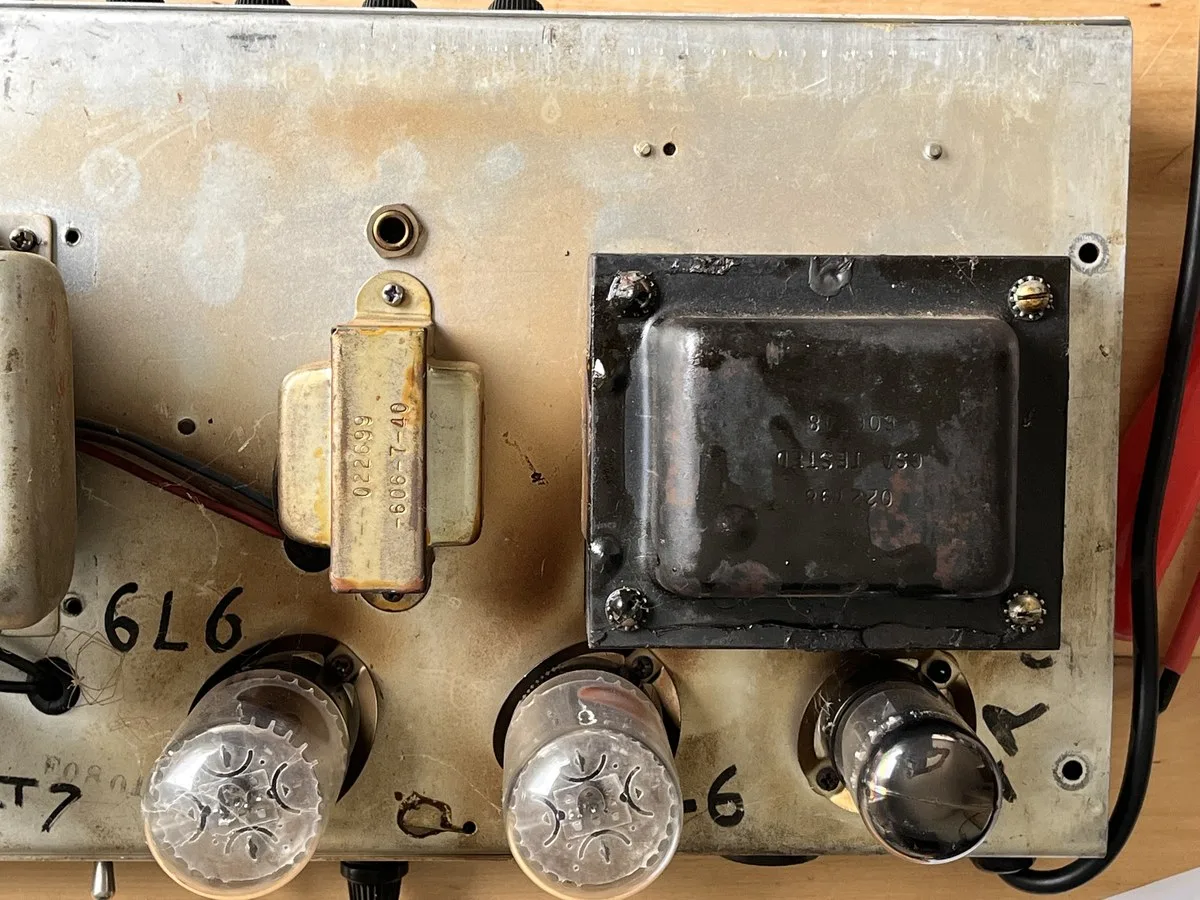
- Output transformer: Schumacher 022699 / 606-7-40, reading as week 40 of 1967
- Reverb transformer: Schumacher 022855 / 606-7-42, week 42 of 1967
- Power transformer: Schumacher 022798 / CSA Tested / 606-7-48, week 48 of 1967


Three independent parts, three independent stamps, all landing within an eight-week window of each other. That's not a coincidence you get from replacement parts fitted at different times over the decades: that's a set of transformers that went into the amp together, on the factory floor, in late 1967. When three unrelated components agree that closely, you can trust the story they're telling.
The pots added a smaller wrinkle worth understanding rather than worrying about: the speed pot's date code reads as 1965: two years earlier than the transformers. That's normal, not a red flag. Fender, like most manufacturers, pulled components from existing stock rather than insisting on parts made the same week as the chassis. A pot made in '65 sitting in a bin until it got fitted in '67 is exactly how a factory production line works, not evidence of a later repair.
And then there was the detail that didn't quite add up cleanly. The original tube chart, still present and largely intact inside the chassis, which is itself a nice find on an amp this age, reads "Fender Musical Instruments." The front panel badge reads "Fender Elect. Inst. Co." Two different names, on two different original parts of the same amp. The date stamp on the tube chart itself wasn't legible enough to pin down on inspection, so it couldn't settle the question directly, but it's a reminder that even original, factory-fitted parts can carry small inconsistencies that look more alarming than they are. Fender's own branding shifted around during this era; a naming mismatch between chart and panel isn't proof of anything sinister, just a snapshot of a company mid-transition.

What was done
No parts needed replacing to answer the dating question: this was reading, not repairing. The transformer codes, cross-checked against each other, gave a confident answer: this is a genuine late-1967 build. The tube chart discrepancy was noted and left exactly as found, since disturbing an original label to satisfy curiosity isn't a good trade.
How it left
An amp the customer now knows the real story of, with the evidence to back it up rather than a guess. The dating work sat alongside the service itself (cleaned pots, sorted wiring, the usual) but the amp's history came out of it too, which is a nice thing to be able to hand back along with the repaired unit.
One stamp on one part is a data point. Three stamps on three unrelated parts, agreeing with each other, is a fact. That's the whole method: never trust a single code in isolation, and treat anything that doesn't fit the pattern as a detail to understand rather than a problem to fix. Most of the time, the amp is exactly as old as its parts say it is. You just have to be willing to go and read them.