What came in
An Ensoniq ESQ-1 digital wave synthesizer, one of the great underrated synths of the 1980s. Eight voices, a built-in sequencer, and a sound that sits somewhere between the digital sheen of the era and something altogether warmer. This one arrived completely dead. No display, no sound, no signs of life. The owner mentioned it had faded out before dying, and that the voice chips had been replaced by a previous repairer at some point.
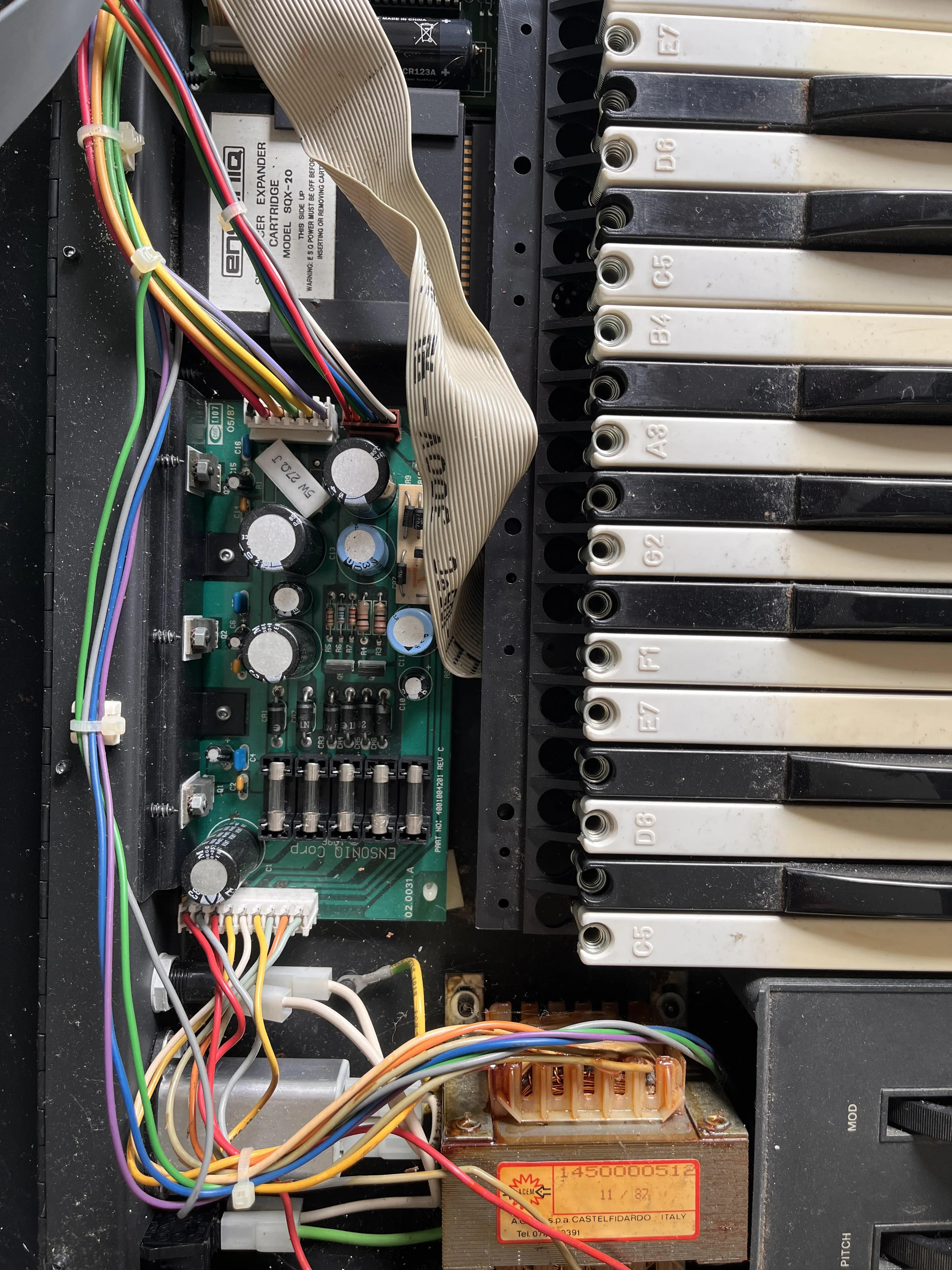
What we found
The power supply checked out fine across all rails: everything within Ensoniq's own service manual specifications. The CPU was running and the 8MHz clock was confirmed on the oscilloscope. The reset circuit was doing its job. The synth was alive underneath. It just had no way of showing it.
The real culprit was sitting in the output stage. A pair of power transistors, a complementary MJE172 and MJE182, form the heart of the audio output circuit. One of them had been running hot for a long time, long enough to cause heat damage to the display board mounted directly above it on the other side of the chassis.


Once the affected area was cleaned up and the solder joints reflowed, the display came back to life on its own. No chip replacement needed: the underlying hardware was fine, it just needed the heat damage undone.

With the display restored, the patch list came up and the synth began to talk to us properly.

More faults then surfaced. Several keys were causing the CPU to crash on contact. Some voice chips weren't producing sound. The output stage op amp was showing an offset fault on one of its four sections, enough to affect the volume control circuit. The volume slider wasn't responding correctly.
Careful fault finding followed. Voltages traced against the service manual. Components tested in and out of circuit. Headers cleaned, solder joints reflowed throughout both the mainboard and display board.

The output stage op amp (a TL084) was found to have an offset fault on one section. A TL074 has been fitted temporarily while the correct replacement part is on order. A new keyboard ribbon cable has also been ordered.
Note: I think the replacement op amp may have re-blown. Need to read the op-amp datasheet and work out how to test that properly before fitting the final part.
Where we are
The display is fully restored and working. The CPU is confirmed running. Audio is present through the output stage. Voice chips are producing sound on a number of keys. The output stage and volume control are still under investigation: parts are on order. This one is still on the bench.
What's been done so far
| Item | Status |
|---|---|
| Output stage op amp (TL084) | Faulty: TL074 fitted temporarily, correct replacement on order |
| Display board & mainboard solder joints | Reflowed; corrosion cleaned throughout |
| Keyboard ribbon cable | On order |
The ESQ-1 is a complex machine with a lot going on inside. This one had clearly had a hard life: a previous repair, years of a failing transistor running hot, and the cumulative damage that comes with it. Sometimes the most important fault is hiding in plain sight. More to follow when it leaves the bench.