What came in
An Electro-Harmonix Big Muff Pi v9. Customer's complaint: sounding thin and weak: lacking the sustain and body it should have. Classic sign that something in the gain chain isn't doing its job.
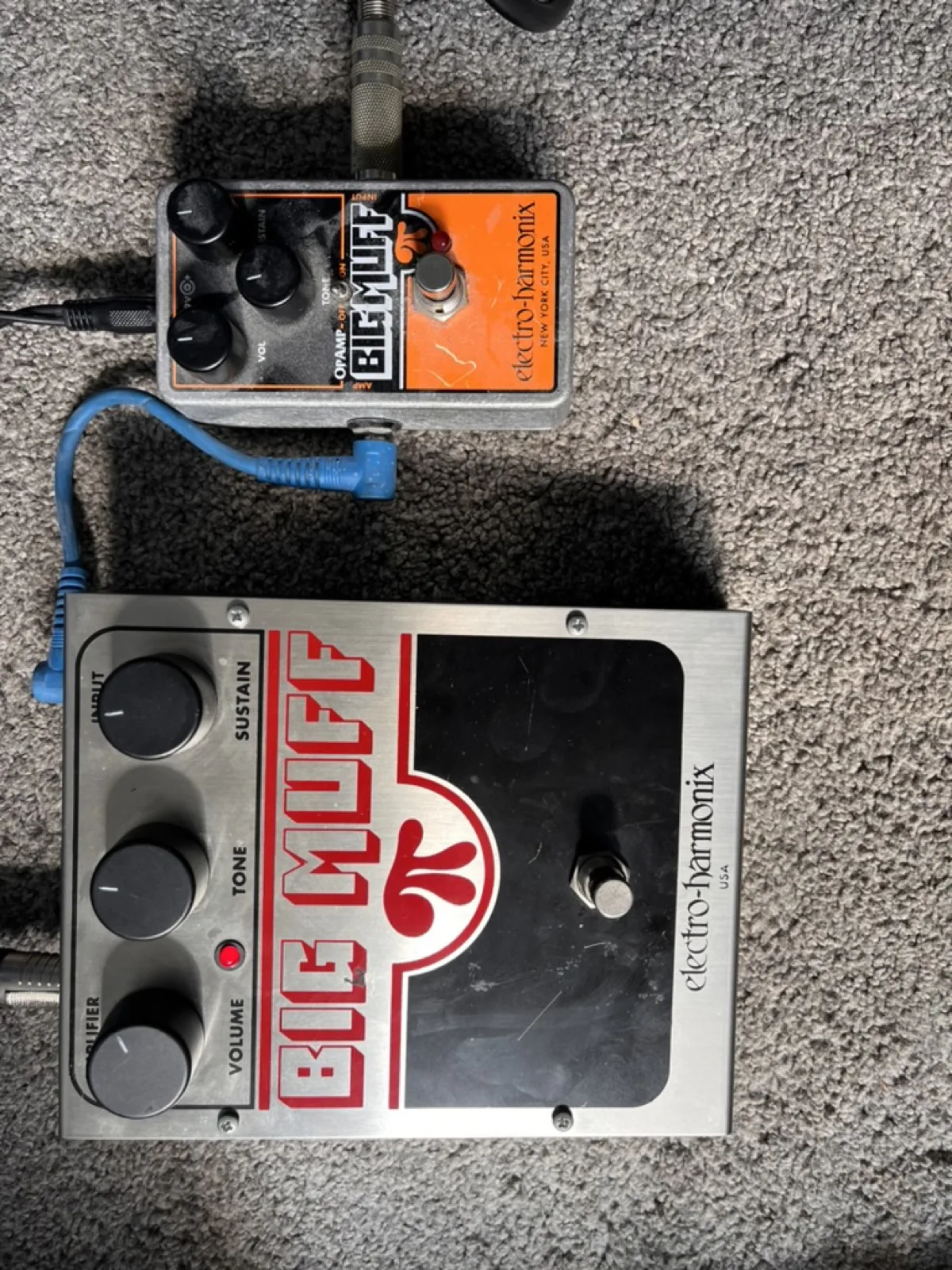
We had a second Big Muff Pi available throughout this repair. Being able to set identical Sustain, Tone and Volume positions on both and compare directly gave us a clear reference point: both for diagnosing the fault and for confirming the fix. If you ever get the chance to work alongside a known-good reference unit, take it.
How the circuit works
The Big Muff uses four NPN transistors, Q1 through Q4, each wired as a common emitter amplifier. Q1 is the input booster, buffering and amplifying the incoming signal. Q2 and Q3 are the clipping stages, where the fuzz actually happens: diodes clip the signal into the characteristic square wave shape. Q4 is the output booster, bringing the level back up after the tone control.
For each transistor to work correctly, the voltages across its three pins need to sit within predictable ranges. On a 9V supply: collector around 4.5V, base around 0.6–0.7V, emitter close to ground. These are the reference points used when diagnosing a fault.
Finding the fault
The first step with any pedal repair is to measure the DC bias voltages at each transistor with a multimeter. This quickly identifies which stage is misbehaving without blindly probing the circuit.
Q1 immediately showed a problem:
| Pin | Measured | Expected | Status |
|---|---|---|---|
| Collector | 0.2V | ~4.5V | Fault |
| Base | 0.7V | 0.6–0.7V | OK |
| Emitter | 0.1V | ~0V | OK |
Base and emitter voltages were spot on: the bias network (the resistors that set the transistor's operating point) was fine. The problem was the collector sitting at just 0.2V, essentially at ground. A saturated transistor: conducting too hard, with almost no voltage drop across it. Q1 wasn't amplifying: it was just passing current straight through.
Tracking down the cause
A saturated transistor with correct base bias points to a few culprits: a short to ground on the collector, a wrong or failed resistor in the collector circuit, or the transistor itself. We worked through each systematically.
With Q1 removed, a resistance check from the collector pad to ground came back open: the PCB was clean. Collector load resistor R13 measured correctly at 10K. That left the transistor as the prime suspect.
Bench testing Q1 in diode mode showed the junctions apparently intact, but this is an important point in transistor diagnostics. A diode test only checks the junctions in isolation. A transistor can pass that test and still fail under real operating conditions, particularly if the collector-emitter path has broken down internally. The only reliable test is substitution.

The fix
Q1 was replaced with a BC550C, a direct equivalent to the original, with the same high-gain NPN characteristics and identical pinout. It's the same transistor type already fitted in other positions on this board, making it a well-matched replacement.
With the new transistor fitted and soldered, voltages came back into range across all four stages. Q1's collector settled at 4.2V, slightly below 4.5V, which is perfectly normal. The exact bias point depends on the hFE (gain) of the specific transistor, and component tolerances in the surrounding resistors. Anything in the 4.0–5.0V range is healthy.
Confirmation
Final confirmation came from the reference pedal. With both units set to identical Sustain, Tone and Volume positions, the repaired Big Muff matched the known-good unit closely: full sustain, the same tone sweep, that characteristic wall of sound fully restored.
This is a good example of a fault that can be tricky to chase down: the pedal still passed audio in bypass, and a basic bench test didn't immediately condemn Q1. Systematic voltage measurement across each stage is the quickest way to isolate which part of the circuit is misbehaving, and substitution is often the only way to definitively confirm a transistor fault. Big Muffs are robust, well-designed pedals and generally very repairable. If yours is sounding thin or lacking sustain, it's worth having the transistor bias voltages checked.