A quick word on Blackstar
Blackstar is a British amp company based in Northampton, started in 2007 by two people who had spent years at Marshall, Ian Robinson and Bruce Keir. They set out to build valve amps that sounded great, were sensibly priced and had a few clever ideas of their own. The best known of those is the ISF control, which lets you slide the tone of the amp between a tighter, more American feel and a rougher, more British one with a single knob.
Their amps caught on quickly. You will see them on stages and in bedrooms all over the world, and the small ones in particular have become a favourite for people who want a real valve sound at a volume the neighbours can live with.
The HT-5R is one of those small amps: a five-watt valve combo with a 12 inch speaker, two channels, reverb, an effects loop, and a headphone and recording output so you can practise silently or plug straight into a computer. For the size, it is loud, it is great fun, and it is the sort of amp that lives next to the sofa and gets played every day. Which is exactly why a fault on one is so annoying.
What came in
This one belonged to a player who had a very particular problem. The amp would sound perfect for about five minutes. Then the volume would start to drain away, gradually, until there was hardly anything coming out of the speaker. Switch it off, give it a rest, and it would be fine again for another five minutes.
If you have ever had an amp do that, you will know the first thought: it must be the valves. A new pair had gone in around six months earlier, and it made no difference. He then asked Blackstar what to do, and the suggestion was to replace the whole circuit board, with a discount on a brand new amp offered alongside it.
Both are fair offers from a manufacturer, but neither is what he wanted. A new board is a big and expensive answer for a small amp, and a new amp means scrapping one he liked and had played for years. He did not want to throw it away if it could be saved, so he asked whether it was worth rescuing. The pattern was the clue: a fault that arrives as an amp warms up and goes away when it cools is usually a part that changes when it gets hot. Worn out valves do not behave like that.
What we found
It started with a health check on the bench: safety tests, a good look inside, and measurements to see what the amp was doing as it warmed up. The amp itself was in good shape, completely original, with no previous repairs or modifications and nothing burnt.
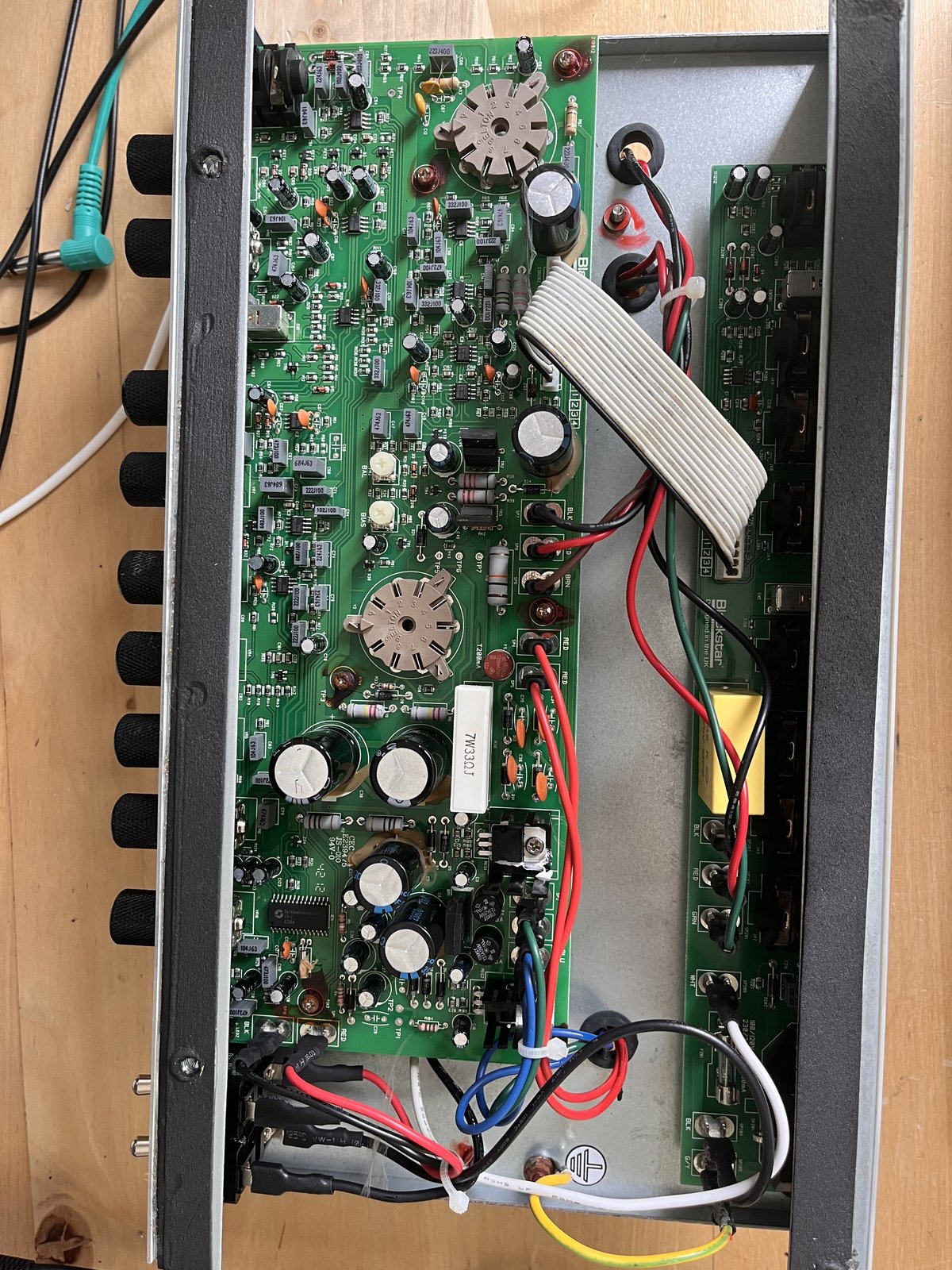
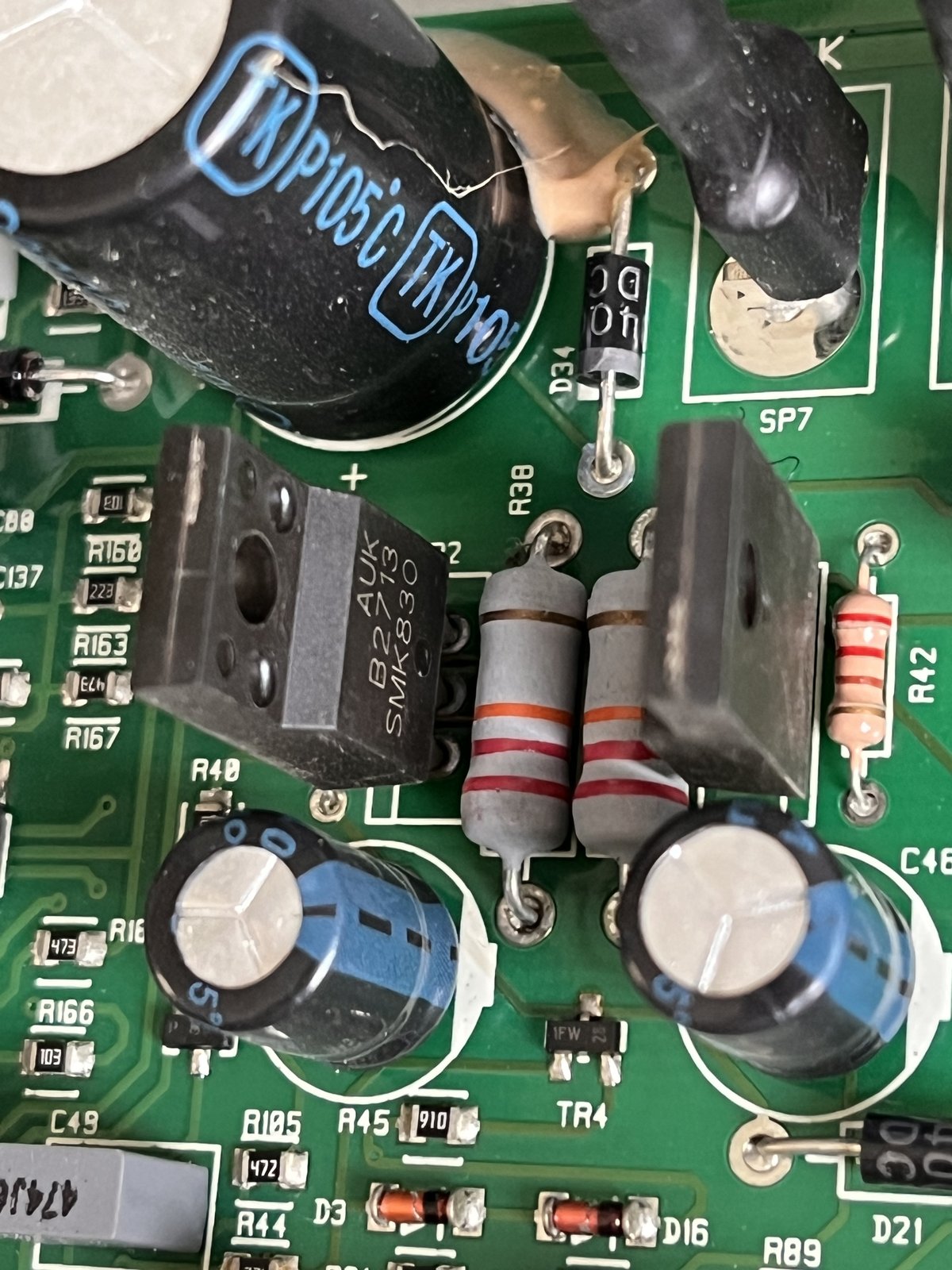
Inside the HT-5R there is a small stage that sits between the preamp and the output valve. Its job is to take the signal and split it into two halves, so the output valve can push and pull to drive the speaker. Most valve amps use a valve for that job; this one uses a pair of small transistors instead.
Think of two people carrying a heavy sofa up the stairs. As long as they share the weight, it goes up smoothly. If one of them starts to let go, the other cannot manage on their own, and the whole thing starts to sag. That is what was happening here. As the amp got hot, one transistor started doing nearly all the work and the other was left carrying almost nothing. Once the pair were that unbalanced, the output valve was no longer being driven properly, and the volume slid away.
When measured, the difference was clear. While the amp was working, the pair were sharing the job fairly evenly. Once the volume had faded, one was working about twice as hard as the other. They were also running very hot, with nothing to take the heat away: no heatsink, squeezed in between large capacitors.
A check of the valve's idle setting (the bias) also found it set quite low, which is common when valves have been swapped without it being reset afterwards. It was not causing the fade, but a valve that is set too cold can make an amp sound a bit thin and harsh, so it was set right while the amp was open.
What was done
The fix was to replace those two transistors with new ones of the same type, in the same places. That was the whole repair.
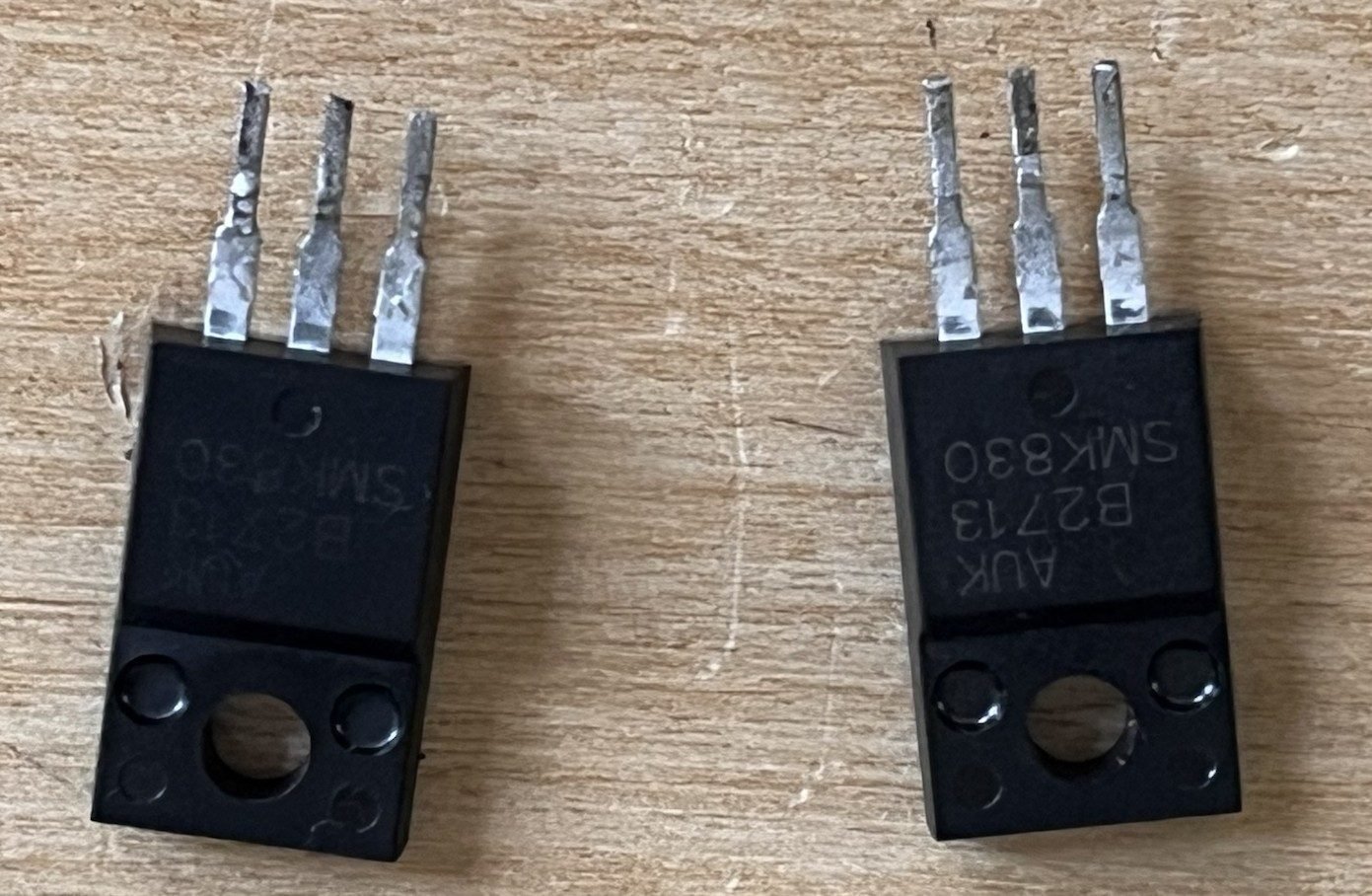
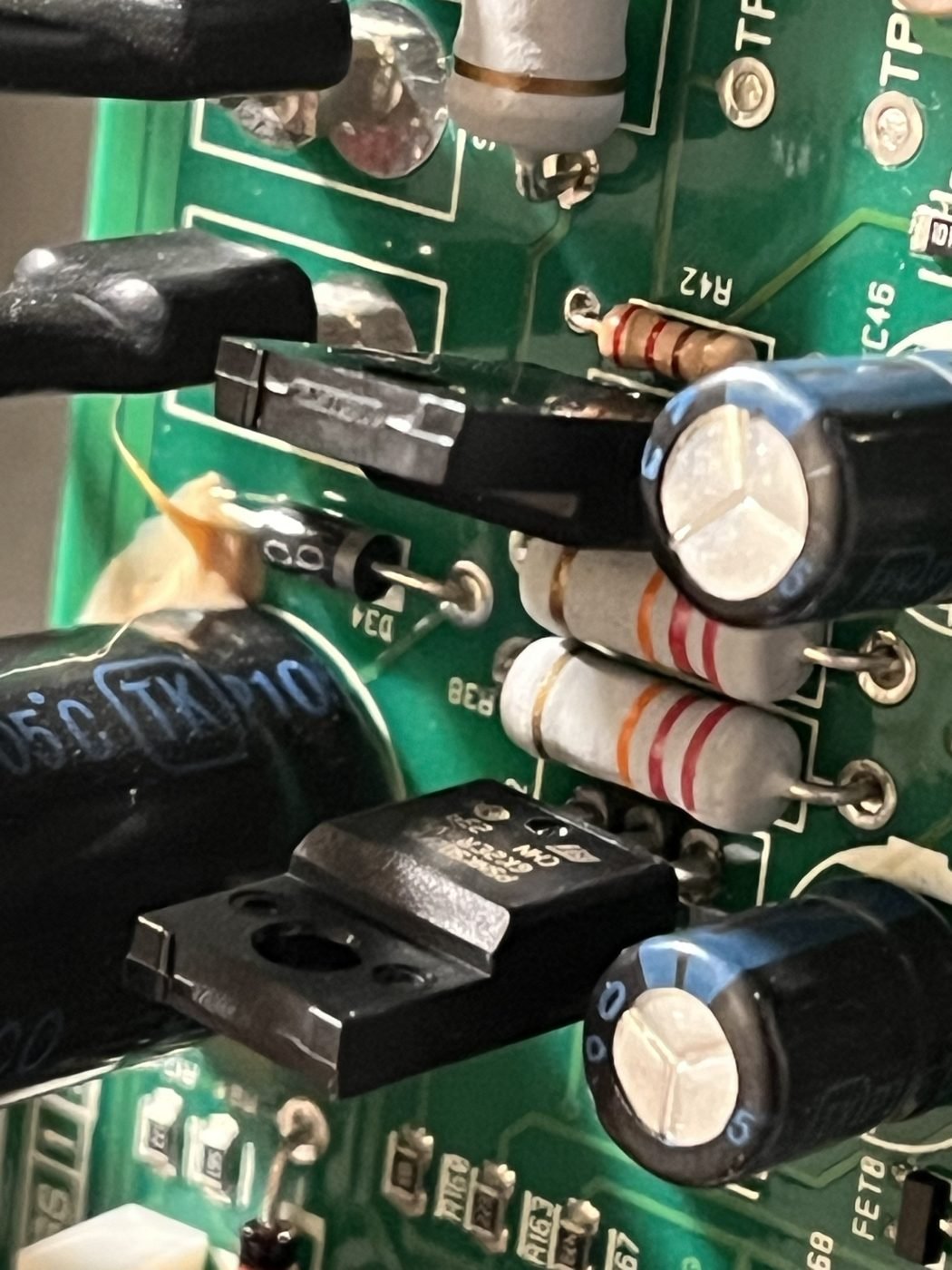
A small heatsink would have been the obvious extra, but once the amp was open there was clearly no room for one: anything big enough to help would be touching the capacitors next to it, and a hot piece of metal pressed against a capacitor does the capacitor no favours. So the amp was left as Blackstar designed it, rather than create a second problem. This is not an unusual story for this amp either; other repairers have written about the same part of the design running hot, and it is a known weak spot.
The valve bias was then reset to just under Blackstar's own setting, which is a little kinder to the valve.
The test that mattered was the one the amp had been failing. It ran for half an hour, measuring as it warmed through, with a guitar played through it for the same time. Before the repair, the volume was gone by about five minutes. After it, the volume stayed put, and the two transistors were sharing the job almost exactly equally.
How it left
The amp passed its safety checks again once it was back in its cabinet. For the final listening test, the whole of Dark Side of the Moon went through it. Before the repair, the volume was fading somewhere around "On the Run". This time it held steady, start to finish.
Two things were worth being honest with the owner about, and worth repeating here.
- That part of the amp still runs hot. With no heatsink, the new transistors still get very hot, around 100 degrees on the body in testing. That is how Blackstar built it. The pair are sharing the load properly now, but the cause of the original problem has not gone away, so it could drift again over a long time. If the volume ever starts to fade again, this is where to look.
- Two older capacitors are worth keeping an eye on. They showed a small amount of leakage once the amp was hot. They are original to the amp, they are a known weak point at this age, and they are not causing a problem yet. Replacing them is worth thinking about as preventive work, but it is not urgent.
If you play, you probably know the cycle: an amp starts to fade, crackle or go quiet, and the first move is to buy new valves. Sometimes that is exactly right. Here, the valves had already been replaced and the fault was somewhere else entirely. The other half of the story is what the owner was offered: a whole new board, or a discount on a new amp. That sounds tidy on paper, but it would have been a poor answer in practice. An amp that comes and goes, or gets worse as it warms up, can usually be tracked down to one or two parts and repaired at that level. That is what a health check is for: it measures first, so the money goes on the part that is actually failing, and nothing gets replaced on a hunch.